Actor portrayals.
Actor portrayal.

Clinical Data

Attruby was proven to make an impact on survival, hospitalizations, and quality of life1,2*

*Defined as health-related quality of life and functional capacity.1

It starts with what's
at stake. And determines
what comes next.

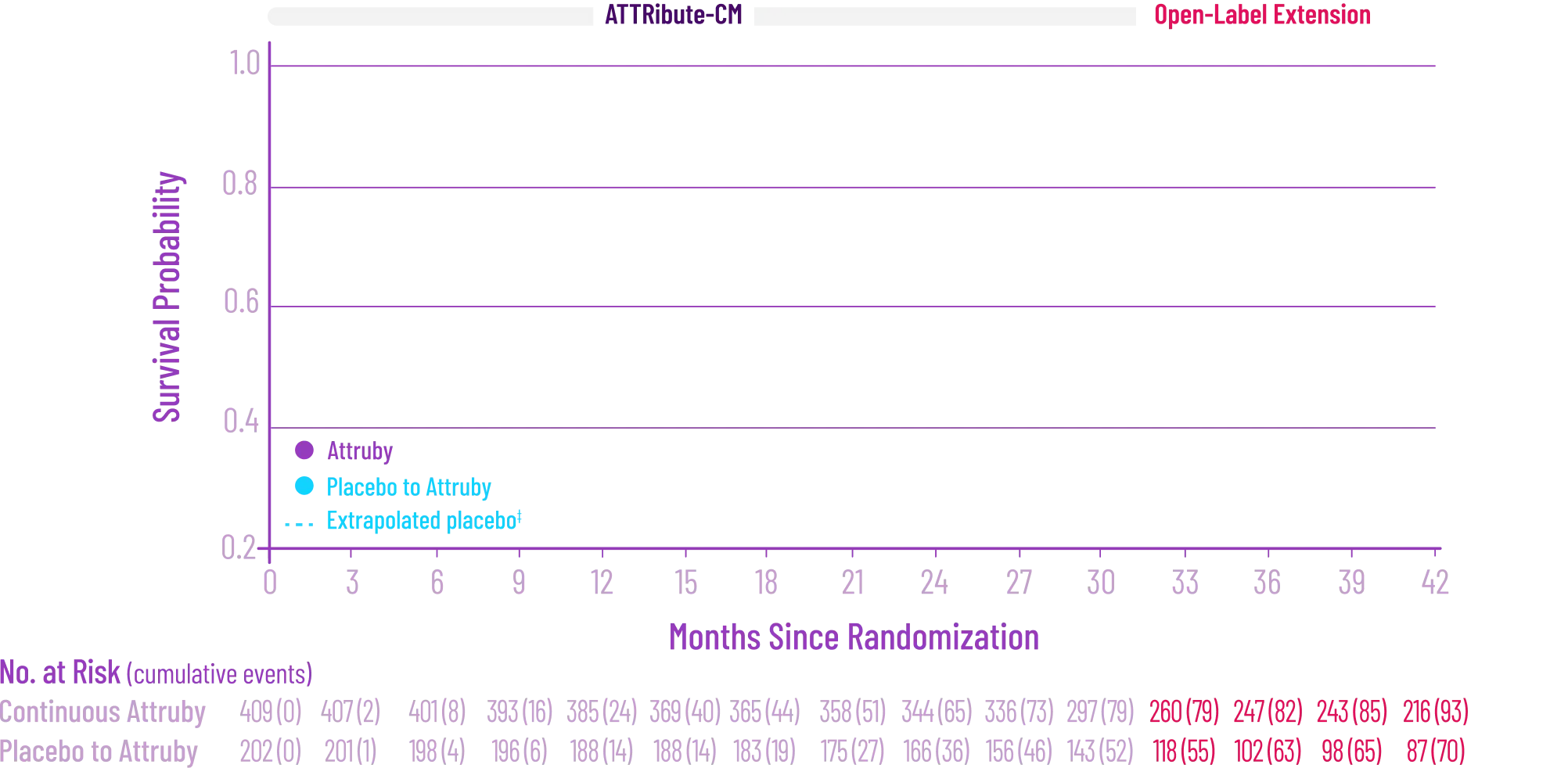
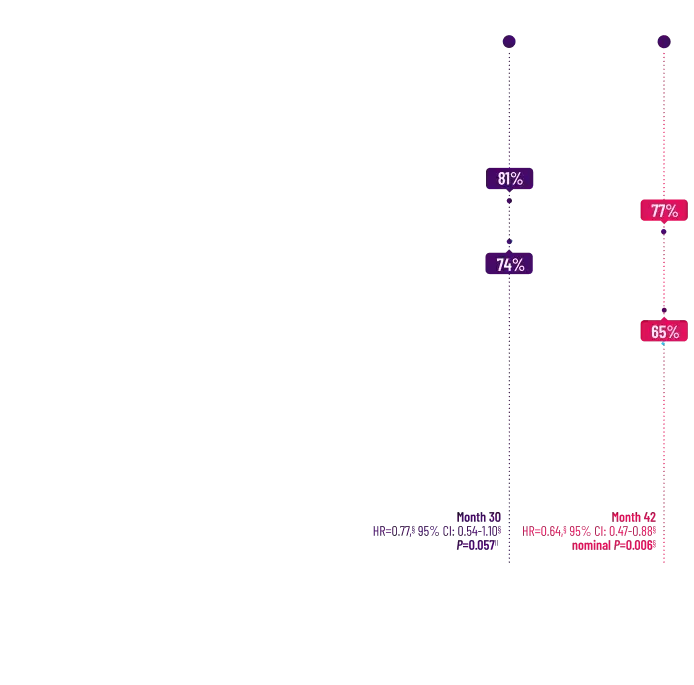
81% of patients on Attruby
remained alive at 30 months
vs 74% with placebo1
Cox HR=0.77 (95% CI: 0.54-1.10);
CMH P=0.057.3
Key Secondary Endpoint:
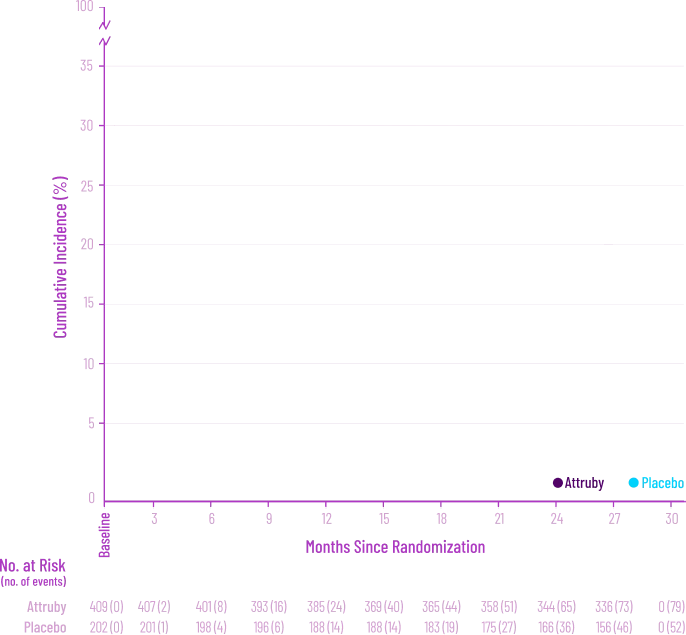
All-Cause Mortality (ACM)2

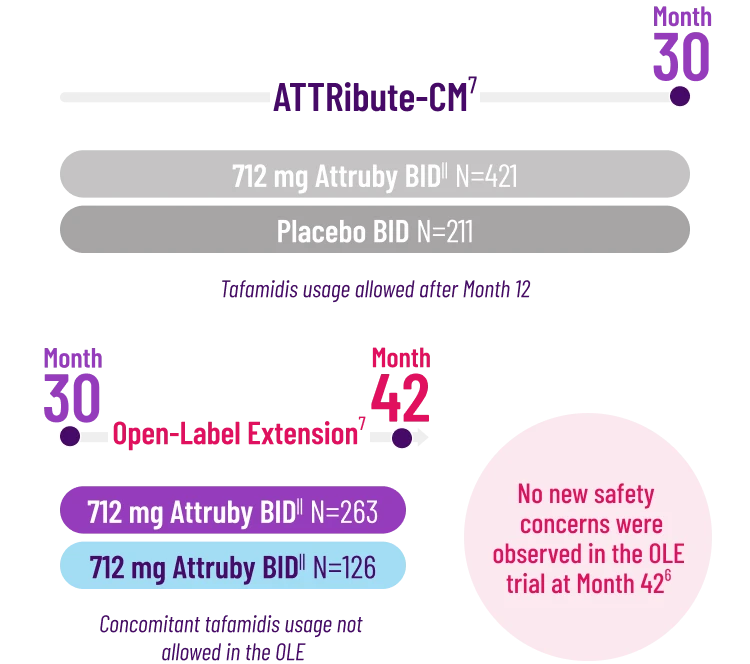
The treatment effect of Attruby on ACM was studied in a contemporary ATTR-CM population that reflects recent approaches in diagnosis and care2,4†

In a post hoc analysis applied to the ITT population, which included patients with stage 4 CKD,
Attruby reduced the risk of ACM5

Cox HR=0.762 (95% CI: 0.524-1.072);
CMH P=0.0396

The proportion of trial participants in the earlier stages of disease (ie, NYHA Class I and II) reflects changes in disease recognition and management in recent
years, which have resulted in improved overall survival.2,4

Based on ITT population of 632 patients, including 21 who had stage 4 CKD. The ITT population was defined as all randomized participants who received at least
1 dose of study drug and had at least 1 postbaseline efficacy evaluation and included participants who had a baseline eGFR <30 mL/min/1.73 m2.2

ACM=all-cause mortality; CKD=chronic kidney disease; CMH=Cochran-Mantel-Haenzel test; CVM=cardiovascular-related mortality; eGFR=estimated glomerular filtration rate; HR=hazard ratio; ITT=intent-to-treat; NYHA=New York Heart Association.

References: 1. Attruby. Prescribing information. BridgeBio Pharma, Inc.; 2024. 2. Gillmore JD, Judge DP, Cappelli F, et al. Efficacy and safety of acoramidis in transthyretin amyloid cardiomyopathy. N Engl J Med. 2024;390(2):132-142. doi:10.1056/NEJMoa2305434 3. Data on file. BridgeBio, Inc.; 2024-2025. 4. Ioannou A, Patel RK, Razvi Y, et al. Impact of earlier diagnosis in cardiac ATTR amyloidosis over the course of 20 years. Circulation. 2022;146(22):1657-1670. doi:10.1161/CIRCULATIONAHA.122.060852 5. Poulsen S, Gillmore JD, Alexander KM, et al. ATTRibute-CM: ITT sensitivity analysis and sub-analysis comparing acoramidis and placebo in stage 4 CKD. Paper presented at: 2024 International Symposium on Amyloidosis; May 26-30, 2024; Rochester, MN. 6. Judge DP, Gillmore JD, Alexander KM, et al. long-term efficacy and safety of acoramidis in ATTR-CM: initial report from the open-label extension of the ATTRibute-CM trial. Circulation. 2025;151(9): 601-611. doi:10.1161/CIRCULATIONAHA.124.072771 7. Judge DP, Gillmore JD, Alexander KM, et al. Long-term efficacy and safety of acoramidis in ATTR-CM: initial report from the open-label extension of the ATTRibute-CM trial. Circulation. 2025;151(suppl 1):1-4. doi:10.1161/CIRCULATIONAHA.124.072771


Attruby was studied in a contemporary
ATTR-CM population that reflects recent
approaches in diagnosis and care

Attruby was studied
in a contemporary
population that reflects
recent approaches in
diagnosis and care

See Study Design

Indication and Important safety information

INDICATION

Attruby® (acoramidis) is indicated for the treatment of the cardiomyopathy of wild-type or variant transthyretin-mediated amyloidosis (ATTR-CM) in adults to reduce cardiovascular death and cardiovascular-related hospitalization.

IMPORTANT SAFETY INFORMATION

Adverse Reactions
Diarrhea (11.6% vs 7.6%) and upper abdominal pain (5.5% vs 1.4%) were reported in patients treated with Attruby versus placebo, respectively. The majority of these adverse reactions were mild and resolved without drug discontinuation.

Discontinuation rates due to adverse events were similar between patients treated with Attruby versus placebo (9.3% and 8.5%, respectively).

Laboratory Tests
Mean increase in serum creatinine of 0.2 and 0.0 mg/dL and a mean decrease in eGFR of 8.2 and 0.7 mL/min/1.73 m2 was observed in the adults with ATTR-CM treated with Attruby versus placebo, respectively, at Day 28 and then stabilized. These changes were reversible after treatment discontinuation.

Use in Specific Populations

Pregnancy & Lactation: There are no data on the use of Attruby in pregnant women. Animal data have not shown developmental risk associated with the use of Attruby in pregnancy. There are no available data on the presence of Attruby in either human or animal milk or the effects of the drug on the breastfed infant or maternal milk production.

Please see Full Prescribing Information including Patient Information.

INDICATION AND IMPORTANT
SAFETY INFORMATION

INDICATION

Attruby® (acoramidis) is indicated for the treatment of the cardiomyopathy of wild-type or variant transthyretin-mediated amyloidosis (ATTR-CM) in adults to reduce cardiovascular death and cardiovascular-related hospitalization.

IMPORTANT SAFETY INFORMATION

Adverse Reactions
Diarrhea (11.6% vs 7.6%) and upper abdominal pain (5.5% vs 1.4%) were reported in patients treated with Attruby versus placebo, respectively. The majority of these adverse reactions were mild and resolved without drug discontinuation.

Discontinuation rates due to adverse events were similar between patients treated with Attruby versus placebo (9.3% and 8.5%, respectively).

Laboratory Tests
Mean increase in serum creatinine of 0.2 and 0.0 mg/dL and a mean decrease in eGFR of 8.2 and 0.7 mL/min/1.73 m2 was observed in the adults with ATTR-CM treated with Attruby versus placebo, respectively, at Day 28 and then stabilized. These changes were reversible after treatment discontinuation.

Use in Specific Populations

Pregnancy & Lactation: There are no data on the use of Attruby in pregnant women. Animal data have not shown developmental risk associated with the use of Attruby in pregnancy. There are no available data on the presence of Attruby in either human or animal milk or the effects of the drug on the breastfed infant or maternal milk production.

Please see Full Prescribing Information including Patient Information.